The Belief Ladder

The best marketing changes how buyers think.

Eugene Schwartz taught us to match a message to a buyer's level of awareness. The Belief Ladder takes that message further, connecting what buyers already think to the results they want, the way they work, and who they aspire to become.

Where you are now

Your relationship with customers is transactional.

You won them on price, a feature, or a result. That got the deal done, and it left the door open for the next vendor with a better number.

Right now the deals are closing and the revenue is real, but something feels thin. Customers buy from you without being loyal to you. Your message works on the people who were already looking and never breaks through to the ones who weren't.

Getting to the next level of revenue takes a message that goes deeper than what you sell.

If you want customers who stay, who refer, and who pick you when a competitor shows up with something shinier, and if you want to reach the much larger group of buyers who aren't shopping yet, you have to change what they believe about how they work and who they are. Most companies never get there, because their message never goes deeper than what they sell.

The way out

Find the belief behind the buying decision.

  1. 01

    Find their awareness level.

    Unaware, problem aware, solution aware, product aware, most aware. Start with the most aware and work backwards. That's where learning is cheapest.

  2. 02

    Match the message.

    Your ad, email, page or post meets buyers where they are and speaks to what they're already thinking.

  3. 03

    Apply the Belief Ladder.

    Take that matched message and express its value three ways.

    • Results. What they get.
    • Change. How they work differently.
    • Identity. Who they become.

    Each level connects your product to a different kind of value: the outcome they achieve, the way they work, or the person or organization they aspire to become.

The Belief Ladder is Rooted in Psychology

Rossiter and Percy proved the model in the 1980s.

The idea that messages work at different depths is not new, and we did not invent it. It comes from John Rossiter and Larry Percy, whose advertising grid has been the standard academic model since the late 1980s and is taught in nearly every advertising program. Their work draws the line between informational appeals, which give the buyer facts, results and an offer, and transformational appeals, which change how the buyer experiences the product or their own situation. In our language those are transactional and transformational. Their grid also showed that the right depth depends on how involved the buyer is in the decision, which is why the same message can land with one person and miss with the next.

Here is the part that turned a model into a method. When researchers later tested the grid, they found that the depth the textbook predicted did not always win. Sometimes a message pitched at an unexpected depth did better, because it made the buyer stop and reconsider. Nobody could reliably predict which depth would win ahead of time. So the only honest way to find out is to run them and watch. That is what the Belief Ladder does.

Aspirational is our extension of their grid one step further. Where transformational changes how a buyer feels about their situation, aspirational changes how they see themselves. Same axis, one rung deeper, and in our experience it is the rung that reaches the people who sign.
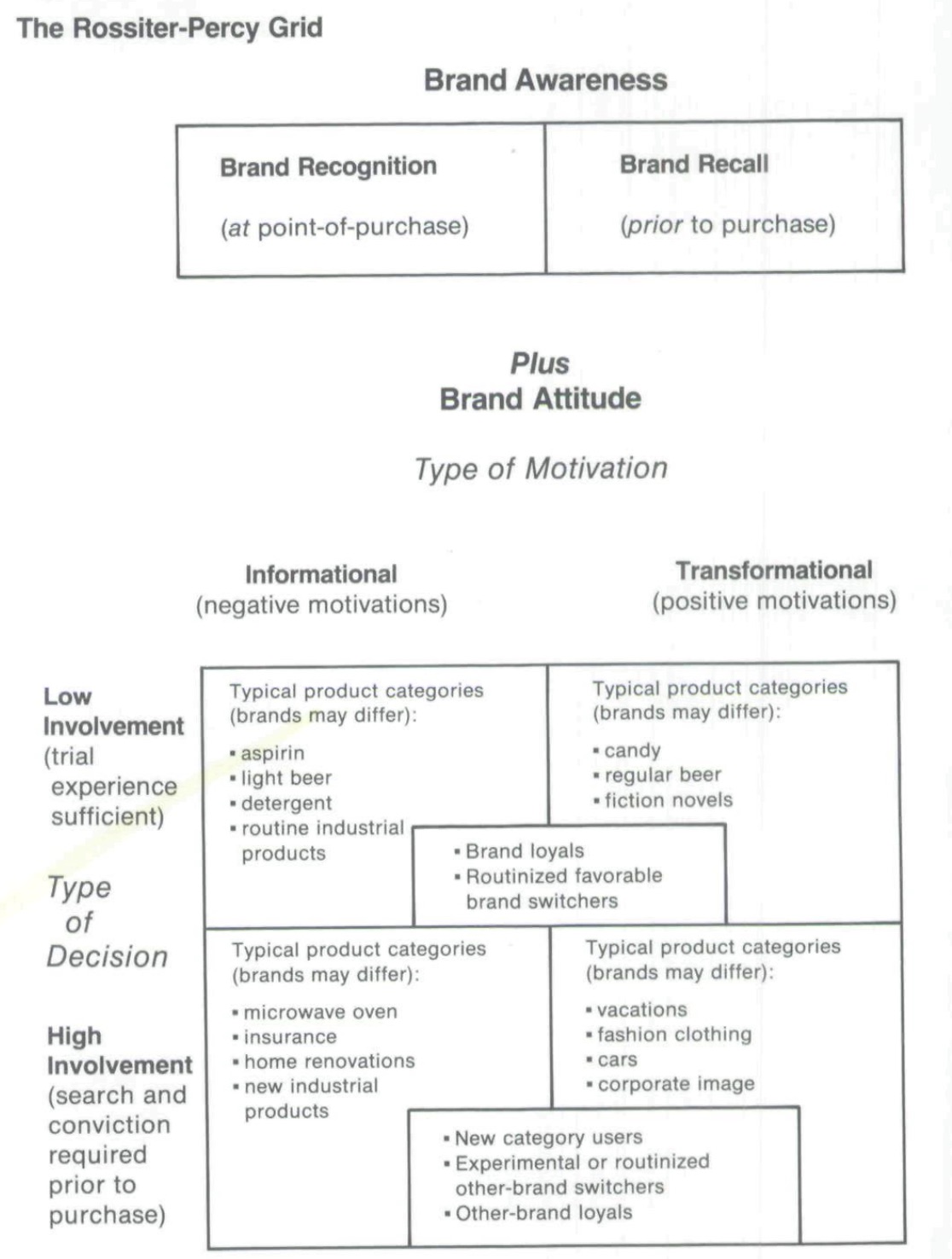
The Rossiter-Percy Grid. Brand awareness splits into brand recognition at the point of purchase and brand recall before purchase. Brand attitude is a grid of motivation, informational or transformational, against involvement, low or high, with typical product categories in each cell.
The Rossiter-Percy Grid.
By channel

The same method, applied to four channels.

The mechanics change with the channel. The method does not. Pick one to see how it runs.

Outbound is the fastest place to learn what a market believes, because every reply is a data point and you choose the list.

  • Find the level.

    We start with accounts showing real buying signals, like a competitor already installed, a relevant hire, or a job post that names the problem. Those are the most aware buyers on the market, and the list grows outward from there.

  • Match the message.

    The first line says what the signal says. If they just hired for the role, the email is about that hire. If a competitor is installed, it is about the competitor. Nothing generic.

  • Test the depth.

    Three sequences go to the same list. One sells the product, one names the cost of what they do today, and one describes who they become. Reply rate by sequence tells us which belief the market is ready to change.

  • Then let the tools run.

    Enrichment, sending and timing run on the tools. We handle the weekly read and change the list and the copy from what it says.

What we measure: replies and meetings by belief level and by signal, rather than open rate.

Examples

What it looks like in practice.

Names withheld. Numbers are theirs.
Paid social, B2B software.

Cut spend in half. Kept the channel that mattered.

A B2B software company was spending about $10,000 a month on LinkedIn ads and could not say what it was buying. Working backwards from closed deals showed that ads were not driving the pipeline, but one platform was touching roughly 40 percent of meetings. We cut spend by about half, kept that platform, and moved the rest into top-of-funnel content where the belief change was actually happening.

Result:

spend fell by half and meetings held steady.

Paid search, AI software.

One ad, three beliefs, four campaigns.

An AI advertising platform was up against two much larger incumbents. The research showed that neither incumbent was bidding on the category, that both ran on rules a person has to write, and that the challenger's AI acted on its own. That difference became the message. We built four campaigns working backwards from competitor searches to demand terms, each with a transactional, a transformational and an aspirational page behind a single ad.

Result:

a test plan where the winning page, rather than the winning headline, tells the company which buyer it is really reaching.

Exit Engine. Go-to-market for B2B software. The Belief Ladder is a method of Exit Engine.